
Ask how long SEO takes and nearly every answer is three to six months. The range is not wrong. It is useless, because it gives you nothing to check in month two and no way to tell in month four whether the work has stalled. A timeline you cannot check suits the person being paid, not the person paying.
The short version. Month one is fixes and tracking, and traffic should not move. Month two brings impressions in Search Console, month three the first clicks from searches that do not contain your name, and months four to six the first leads you can count. Months six to twelve are where it compounds, if the publishing keeps going. A new domain, a crowded market or a second language slows every stage.
- Month one of SEO is fixes and tracking, and flat traffic is normal; worry if nobody can list what was fixed.
- Impressions should rise in month two and non-branded clicks appear in month three, both readable in Search Console's Performance report.
- Months four to six should bring leads you can count and attribute to pages, and traffic with no enquiries means the wrong traffic or a broken path.
- Ahrefs' 2025 study found only 1.74% of newly published pages reached the top 10 within a year, and the average number-one page was five years old.
- A new domain, lost redirects, a crowded search, a second market or publishing in bursts slows every stage.
What the public data says
The largest public study of this we could check is Ahrefs' own, updated in May 2025. It followed a million random URLs its crawler first saw in September 2023. Only 1.74% of those newly published pages reached Google's top 10 within a year. Of the pages that did get there, 40.82% did it within a month.
The same study looked at the top 10 results for 1.3 million US keywords. Of those pages, 72.9% were more than three years old, and the average page in position one was five years old.
Two readings are fair, and both are ours rather than Ahrefs'. The URLs were random, not pages somebody was actively working on, so 1.74% is a base rate and not your odds. And the pages holding the top spots are mostly old pages that kept being improved. That is the case for treating SEO as a twelve-month commitment rather than a one-quarter trial.
Google will not give a timeline at all. Its guidance on hiring an SEO puts it plainly: "No one can guarantee a #1 ranking on Google."
Months 1 to 3: the 99-day sprint
Our SEO work runs the first 99 days as a published sprint in three phases. They map closely onto the first three months, so here is each one with what you should see and what should worry you.
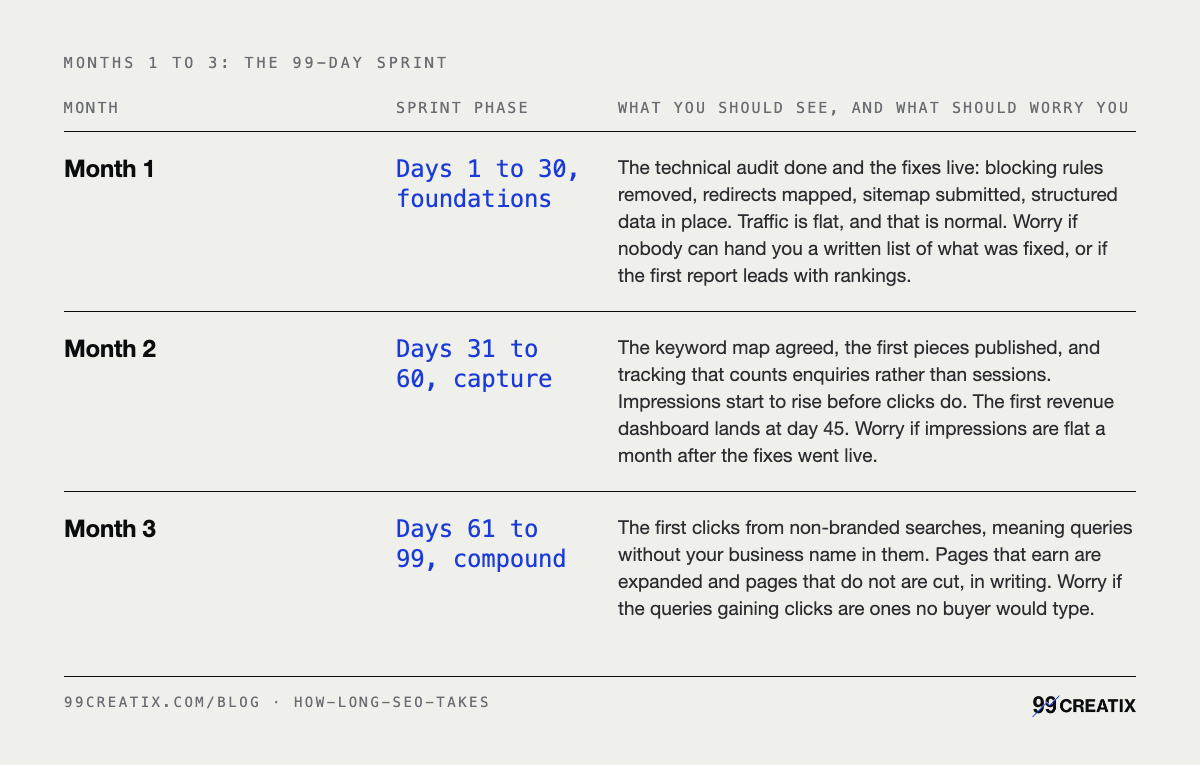
You can watch all of this yourself. The Performance report in Google Search Console groups results by query and by page, with clicks, impressions, click-through rate and average position. Exclude queries containing your brand name before reading it. Branded clicks rise when advertising or word of mouth does, and they say nothing about whether SEO is working.
For a UK fashion house, organic traffic rose 47% in the 90 days after launch, compared with the 90 days before, while paid spend came down.
One client, measured in its own analytics, not an average. The case study shows how it was measured.Months 4 to 6: leads you can count
This is where a small business should expect SEO to start showing up as enquiries, not only as traffic. Pages published in month two have had time to settle. Some will have reached page one. More will be sitting on page two, which is a useful place for a page to be, because it needs improving rather than replacing.
Ahrefs gives the same advice in its study: if a page is still outside the top 10 after about six months, look at updating it. That matches how we run the work.
What you should see: organic leads in the tracking, attributed to specific pages, and a report that names which pages produced them. What should worry you: traffic rising with no enquiries attached. That is either the wrong traffic or a broken path from page to enquiry, and traffic but no leads sets out how to tell which.
Months 6 to 12: compounding, or a hard question
If the first six months went to plan, new pieces start ranking faster than the early ones did, because the site now has depth on its subject and pages that link to each other. That is our observation from running the work, not a published rule. The share of clicks from non-branded searches should keep rising.
For a UAE law firm, non-branded clicks rose 3.4 times in six months. The case study sets out what was done. Again, one client, and a result at the six-month mark rather than the three-month one.
What should worry you: nine months of steady publishing with nothing non-branded to show for it. At that point the question is not patience. Either the searches you are targeting are not made often enough to matter, or something technical is still capping the site. Technical SEO in plain words covers how to check that without buying a tool.
What makes it slower
Every stage above stretches when one of these is true.
- A new domain. A site with no history and no links pointing at it starts behind one that has both. Expect the month-two and month-three milestones to arrive later.
- A redesign that lost the old addresses. If a rebuild changed every URL without redirects, the first months go on recovering what the old site had earned before any new ground is gained.
- A crowded commercial search. Most top-10 pages in the Ahrefs data were more than three years old. A new page on a contested search is up against years of accumulated links.
- A second market or language. Two markets need two sets of pages and signals, and each one runs its own clock.
- Publishing in bursts. Four pieces a month for a year builds depth on a subject. Twelve pieces in March and none after that does not.
What makes it faster is the reverse: an established site with pages already on page two, where the job is improving what exists rather than building from nothing.
The 1.74%, 40.82%, 72.9% and five-year figures are from Ahrefs' study How Long Does It Take to Rank in Google, by Patrick Stox, published 15 May 2025 and checked 15 September 2026. Its samples were one million random URLs first seen in September 2023, and the top 10 results for 1.3 million US keywords. The no-guarantee quote is from Google Search Central's page on hiring an SEO, last updated 5 June 2026. The Performance report's groupings and metrics are from Google's Search Console help. The 99-day sprint phases and the day-45 dashboard are from our published SEO service page. The $1,350 monthly rate is our published price, listed on the pricing page. The month-by-month milestones, the warning signs, the list of what slows SEO and the reading of 1.74% as a base rate are our editorial judgement, not survey data. The 47% organic traffic and 3.4x non-branded clicks figures are from our own client engagements, measured as set out on each case study page.
When the timeline is the wrong question
If the business needs customers this month, no SEO timeline helps, and paid search is the honest answer. If nobody searches for what you sell, the timeline never ends. And if the site cannot turn visitors into enquiries, faster SEO only means more people leaving sooner.
Where it does apply, our SEO is $1,350 a month standalone for a single-market site, covering the sprint above with four pieces of content a month. A second market or language, more content per month or a large catalogue moves that number. How soon you want results does not. Every line is on the pricing page.
Ask three questions at every checkpoint: what was fixed or published, which queries gained impressions or clicks, and which enquiries came from which pages.
If the answers in month five are the same as in month two, the timeline has stopped, whatever the report says.