Most of what has been written about AI Overviews reads like a eulogy for organic traffic: a large percentage, a falling line, and advice that stops at "adapt". None of that tells a business owner whether it is happening to their own site, which of their searches are affected, or whether any of it has touched a single enquiry.
The short version. Yes, AI Overviews reduce clicks, and three independent studies point the same way. The loss falls mostly on informational searches, the questions people ask before they are ready to buy, while short commercial, local and branded searches trigger far fewer summaries. So check Search Console before you panic, split your queries by type, and judge the damage in leads and revenue rather than sessions. If you want to know what the assistants themselves say about you, the free AI visibility check answers that in a working day.
- AI Overviews do reduce clicks: Pew found users clicked a traditional result on 8% of visits with an AI summary against 15% without.
- The loss falls mostly on question-shaped informational searches, while short commercial, local and branded searches trigger far fewer summaries.
- In Search Console, rising impressions with falling clicks on the same query is the signature, and falling impressions is a different problem.
- The Generative AI performance report shows which pages appear in AI features by impressions, but not clicks or queries, so pair it with the main report.
- Judge the damage in enquiries and revenue by landing page, because many of the lost clicks were readers rather than buyers.
What the evidence says
Three sources with three different methods. Each measures the whole of Google, not your site, which matters later.
- Pew Research Center, July 2025. Pew tracked the browsing of 900 US adults through March 2025. On visits to a results page with an AI summary, users clicked a traditional result 8% of the time, against 15% without one. They clicked a link inside the summary on 1% of visits, and ended their browsing session on 26% of those pages, against 16%. The full study is short and worth reading.
- Ahrefs, February 2026. Using Search Console data across 300,000 keywords, Ahrefs measured a 58% lower average click-through rate for the top-ranking page when an AI Overview was present, comparing December 2023 with December 2025. It also found click-through falling on informational keywords with no Overview at all, so not every lost click is the Overview's doing.
- SparkToro, June 2026. From a clickstream panel, SparkToro reported that 68% of US Google searches in the first four months of 2026 ended without a click. Its figure of nearly 60% fewer clicks when an Overview appears is cited from Ahrefs, not measured separately.
The direction is not in dispute. The size of the effect on your business is a separate question, and only your own data answers it.
Check whether it is happening to you
Twenty minutes in Google Search Console, in this order.
- Compare like with like. Open the Performance report for search results and compare the last three months with the same three months a year earlier. Comparing with last month lets a seasonal dip pass for an AI effect.
- Read impressions and clicks together, by query. Impressions flat or rising while clicks fall on the same query is the pattern to look for. Your result is still being shown and people are no longer clicking it, which is what a summary answering the question looks like.
- If impressions fell too, this is a different problem. Falling impressions mean you are being shown less, which points to rankings, demand or indexing. Why your website is not showing on Google is the triage for that.
- Open the Generative AI performance report. Google says it reached all websites on 31 August 2026. According to its help documentation, it shows impressions in features such as AI Overviews and AI Mode by page, country, device and date. It shows no clicks and no queries, so use it to see which pages appear in summaries, then take those pages back to the main report.
Rising impressions with falling clicks on the same query is the signature of an AI summary taking the click. Falling impressions is a different problem with a different fix.
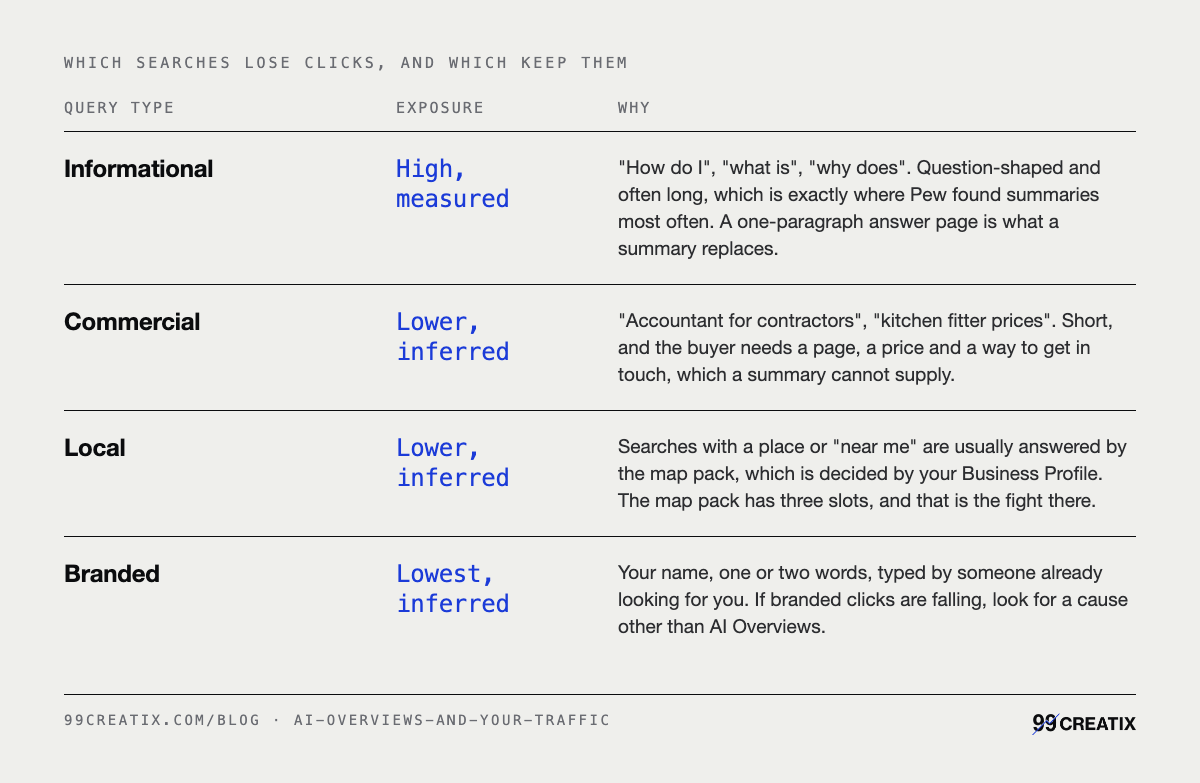
Always compare against the same months last year.Which searches lose clicks, and which keep them
Pew measured the shape of queries, not their intent. It found that 60% of searches starting with words such as who, what, when or why produced a summary, as did 53% of searches of ten words or more. Only 8% of one- or two-word searches did. Matching those shapes to buyer intent, as the table does, is our inference.
What to change
- Stop publishing pages whose whole job is a one-paragraph answer. Answer the question in the first lines, then give the reader a reason to stay: your price, your method, a comparison, a worked example. The approach is in write for the question, not the keyword.
- Move effort towards commercial and local pages. Service pages that state what you do, for whom and from what price, and a complete Business Profile. These are the searches that still send clicks, and they send buyers.
- Be a source the summary can quote. Plain statements of fact get lifted. With Pew measuring 1% of visits clicking a link inside a summary, treat being cited as exposure rather than traffic. The work has three acronyms and is one job.
- Check the assistants as well as Google. The same buyer may ask ChatGPT instead. Can ChatGPT find your business is a ten-minute check, and what AI search visibility costs covers the ongoing version.
Why sessions are the wrong number to mourn
A session is a visit, not a customer. The clicks AI Overviews remove are concentrated on informational questions, and most people asking those were never going to buy that day. If sessions fell and enquiries held, you lost readers rather than buyers. That is worth knowing before you spend money chasing the lost visits back.
So set the report up around money. Enquiries and sales by landing page, month on month and year on year. Organic sessions belong in the report as context, not as the headline. If enquiries from commercial pages are falling, that is the problem worth fixing, and AI Overviews are rarely the whole cause.
The 8% and 15% click rates, the 1% in-summary click rate, the 26% and 16% session-ending rates, and the 60%, 53% and 8% summary rates by query shape are from Pew Research Center's study of 900 US adults' browsing in March 2025, published 22 July 2025. The 58% lower position-one click-through rate is from Ahrefs' study of 300,000 keywords comparing December 2023 with December 2025, published 4 February 2026. The 68% zero-click figure is from SparkToro's analysis of US Google searches from January to April 2026, published 9 June 2026. SparkToro's figure of nearly 60% fewer clicks with an AI Overview is cited from Ahrefs rather than measured by SparkToro. The contents of Search Console's Generative AI performance report and its 31 August 2026 rollout to all websites are from Google's Search Console help documentation, read 15 September 2026. The mapping of query shapes to commercial, local and branded intent, the Search Console diagnostic and the advice to measure enquiries over sessions are our editorial judgement. No prices are cited.
When this playbook does not help much
One honest exception. If your business earns from informational traffic itself, through advertising, affiliate commission or a publication, the lost clicks are lost revenue. Moving effort to commercial pages does not replace them, and the answer is a harder conversation about the business model than any page change.
For everyone else, the useful first step is the comparison in Search Console: this quarter against the same quarter last year, impressions against clicks, one query at a time. Then ask one question of every page that lost clicks: did it ever produce an enquiry?