
Most advice on website quotes says get three and compare them, and stops there. The totals are the least comparable thing on the page. One quote includes copywriting and one assumes you will write it. One names eight pages and one names none. Comparing the totals compares what each agency chose to leave out.
The short version. Read a quote for its scope before its price: how many pages, how many rounds of feedback, who writes the words, what the SEO line delivers, who owns what, and what a change costs. Our own Launch quote is $4,900 for a custom site of up to eight pages, and it is taken apart below as the worked example. What moves it is scope, such as more pages, a store, integrations or a second language. If a line on the quote you hold cannot be explained in one sentence, ask for that sentence before you sign.
- Read a website quote for its scope before its price, because totals only compare what each agency chose to leave out.
- Our Launch quote is $4,900 for up to eight pages: $2,600 design, $1,450 build, $500 technical SEO and $350 copy, and more pages or a store move it.
- Five red flags: no page count, no revision limit, the domain in the agency's name, no ownership clause, and change requests with no pricing method.
- Without a written clause, a commissioned website does not automatically belong to the client in the US or the UK, so ask for the ownership clause.
- Compare two quotes by mapping both onto six rows, marking missing lines as not included, and adding up the totals last.
Our $4,900 quote, taken apart
Here is our Launch build as it appears on the pricing page, with what each line means and what the vague version of the same line looks like on other quotes. A vague line is not always dishonest. It is always impossible to compare.
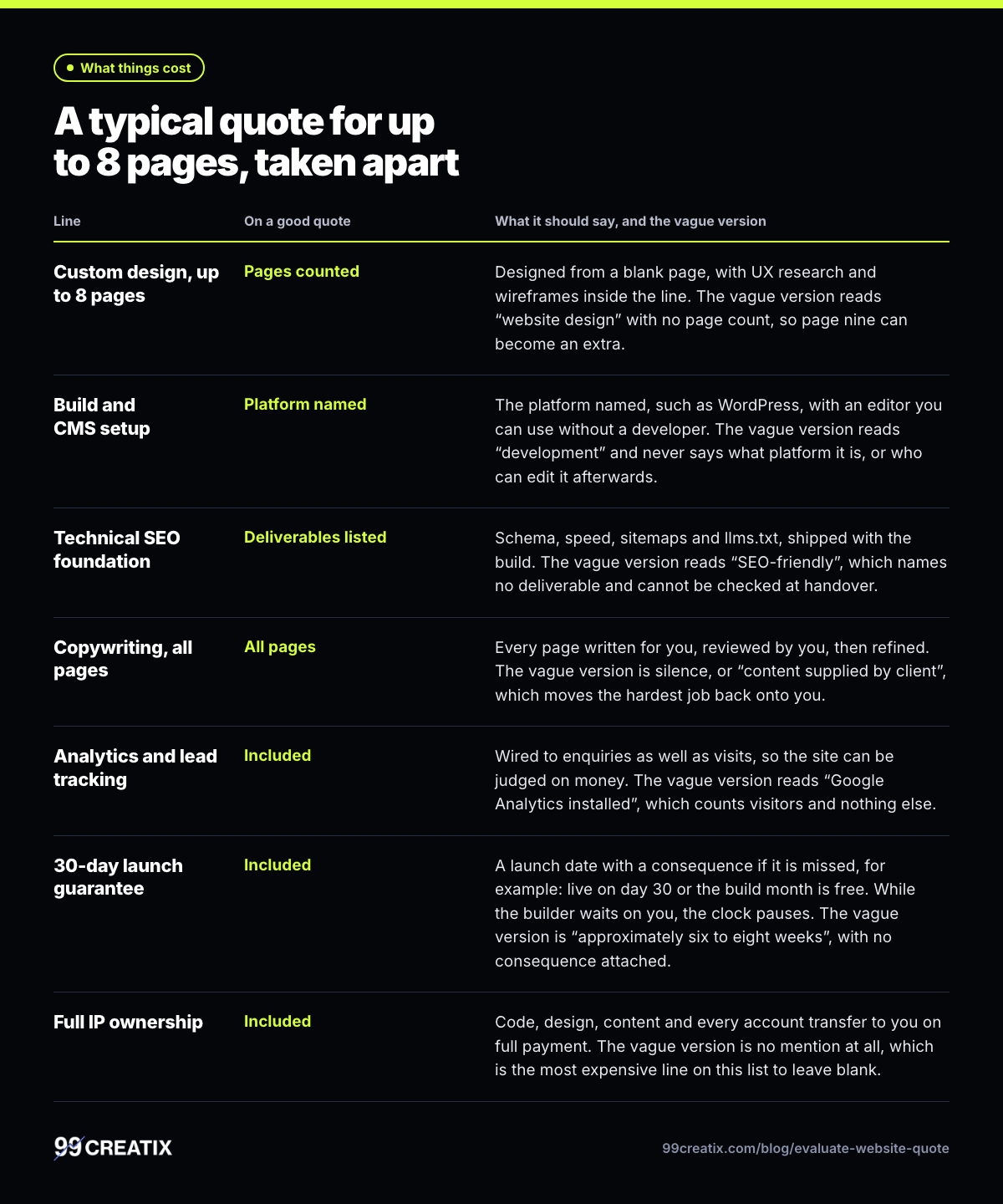
The $4,900 is a floor for that scope, not a price for every website, and the 30-day launch page sets out the review gates it comes with. The service page itemises the four lines. More than eight pages moves it. So does a catalogue with checkout, which starts at $5,900, a booking engine or CRM integration, a second language, a large migration with years of addresses to redirect, or original photography. Each is scoped in writing before anything is signed. How urgently you need the site, and how large the business looks, do not move it.
Five red flags on any quote
- No page count. A design line without a number of pages cannot be priced against anything. It also leaves room for the agency to decide later which pages were in the price.
- "Design" with no revision limit. "Unlimited revisions" sounds generous. It usually means the limit exists and is unwritten. An honest quote says how many rounds there are and what happens after them. Ours is two review gates, at day 10 and day 22, and nothing new enters scope after the second.
- Hosting or domain in the agency's name. If the domain is registered to them, it is theirs to renew and theirs to hold when you leave. Register it to your business, with your own email as the contact, and give the agency access.
- No ownership clause. Silence does not default to you. The US Copyright Office's circular on works made for hire says a commissioned work only counts as the client's in nine listed categories, and only with a written agreement signed by both sides. The UK government's guidance on copyright ownership says the first owner is whoever created the work, not the commissioner, unless agreed otherwise in writing. Ask for the clause.
- Change requests undefined. If the quote does not say how a change is priced, it gets priced at the moment you most need it. Look for a rate, a method, or a sentence saying changes are scoped in writing before work starts. The change request is one of the fees agencies hide, alongside four others worth checking for.
What belongs on the quote but outside the total
Hosting, the domain, premium plugins, photography and advertising spend are costs you pay whoever builds the site. A good quote names each one, who pays it and whose account it sits in. A quote that mentions none of them is not cheaper. It has moved those costs to a later invoice. Typical ranges for each are in what a website actually costs.
Seven questions to ask before you sign
- How many pages are included, and which ones?
- How many rounds of design feedback are there, and what does a round after that cost?
- Who writes the words, and by what date do you need anything from me?
- What does the SEO line deliver, as a list I can check at handover?
- Whose name are the domain, hosting and analytics accounts in, and what do I take with me if we part ways?
- What happens, in money and in days, if I ask for something not on this page?
- What happens if the site launches late for reasons on your side?
Ask for the answers in writing. How long they take to arrive tells you something too.
How to compare two quotes line by line
Write six rows down the side of a page: design with its page count, build and editing, copy, technical SEO, tracking, and ownership with terms. Give each quote a column. Where a quote has no line for a row, write "not included" rather than leaving a blank, then ask what adding it would cost. Only then add up the columns.
This changes most comparisons. A quote that leaves out copy and technical SEO should be set against ours minus the $350 and $500 lines, not against the $4,900 total. The words still have to come from somewhere, and a site without the technical groundwork usually pays for it later.
If two quotes cover the same six rows, the difference in price is a difference in people and process. If they do not, the difference in price tells you nothing yet.
Fill the grid first. Compare totals last.For context, the median custom small-business build among agencies that publish a price in our prices study was $7,000, from a sample of six, with a range of $4,000 to $18,000. Most agencies make this exercise hard: 78.6% of those we checked published no prices at all. If the real choice is between an agency, a freelancer and building it yourself, agency vs freelancer vs DIY sets the three side by side.
The $4,900 Launch build, its four priced lines ($2,600, $1,450, $500 and $350) and the $5,900 e-commerce floor are our published prices. The included tracking, launch guarantee, IP ownership and review gates at day 10 and day 22 are our published terms, listed on the pricing and web design service pages. The $7,000 median custom build (n=6, range $4,000 to $18,000) and the 78.6% no-published-price figure are from our August 2026 study of top-listed web design agencies, linked in the text. The US ownership rule is from the US Copyright Office's Circular 30, Works Made for Hire (revised August 2024). The UK rule is from GOV.UK's Ownership of copyright works guidance (published 19 August 2014). Both were read on 15 September 2026, and neither summary is legal advice. The vague version of each line, the five red flags, the seven questions and the six-row comparison method are our editorial position from reading the quotes clients bring to us, not survey data.
When the cheaper quote is the right one
Not every business needs six rows. If the site exists so people can check you are real before they call, a template and a weekend will do. A detailed quote would be solving a problem you do not have.
A shorter quote can also be the honest one. If you already have the words, the photographs and a clear brief, a freelancer quoting design and build alone is quoting the job that is left. And this method does not fit every project. A store, an app or a large migration should produce a longer quote, not a shorter one. Expect the migration as its own line with a redirect map named, because a redesign that loses the old addresses is how a website drops out of Google.
Whichever quote you choose, get four things in writing: the page count, the revision limit, the ownership clause and the change process. Those four lines settle most disputes before they start.