
Search this question and nearly every result is written by a freelance designer, and each one concludes that you should hire a designer. None says plainly when doing it yourself is fine. They also argue about the wrong thing. The debate is framed as a good logo against a bad one, when the part of branding that changes your numbers is not visual at all.
The short version. DIY branding is fine when the business is early, sells one thing to one kind of buyer, and can already say in one sentence what it does. It stops being fine when other people start applying the brand, when you want to own the mark outright, or when customers cannot describe what you do. The part DIY skips is positioning, and no logo tool does it for you. Ours is $1,800 for positioning, identity, messaging and guidelines over about three weeks, and several audiences, naming work or a large rollout of signage and packaging move that number.
- DIY branding is fine when the business is early, sells one thing to one kind of buyer, and can already say in one sentence what it does.
- It stops being fine when others apply the brand, when you want to own the mark outright, when you add a second audience, or when customers cannot describe you.
- The part DIY skips is positioning, because no logo tool decides who you are for or what to give up.
- Template logos, prompted AI logos and commissioned logos without a written assignment each carry an ownership trap, so check before registering or printing.
- Ours is $1,800 for positioning, identity, messaging and guidelines over about three weeks, and several audiences, naming work or a large rollout move it.
What each route actually gives you
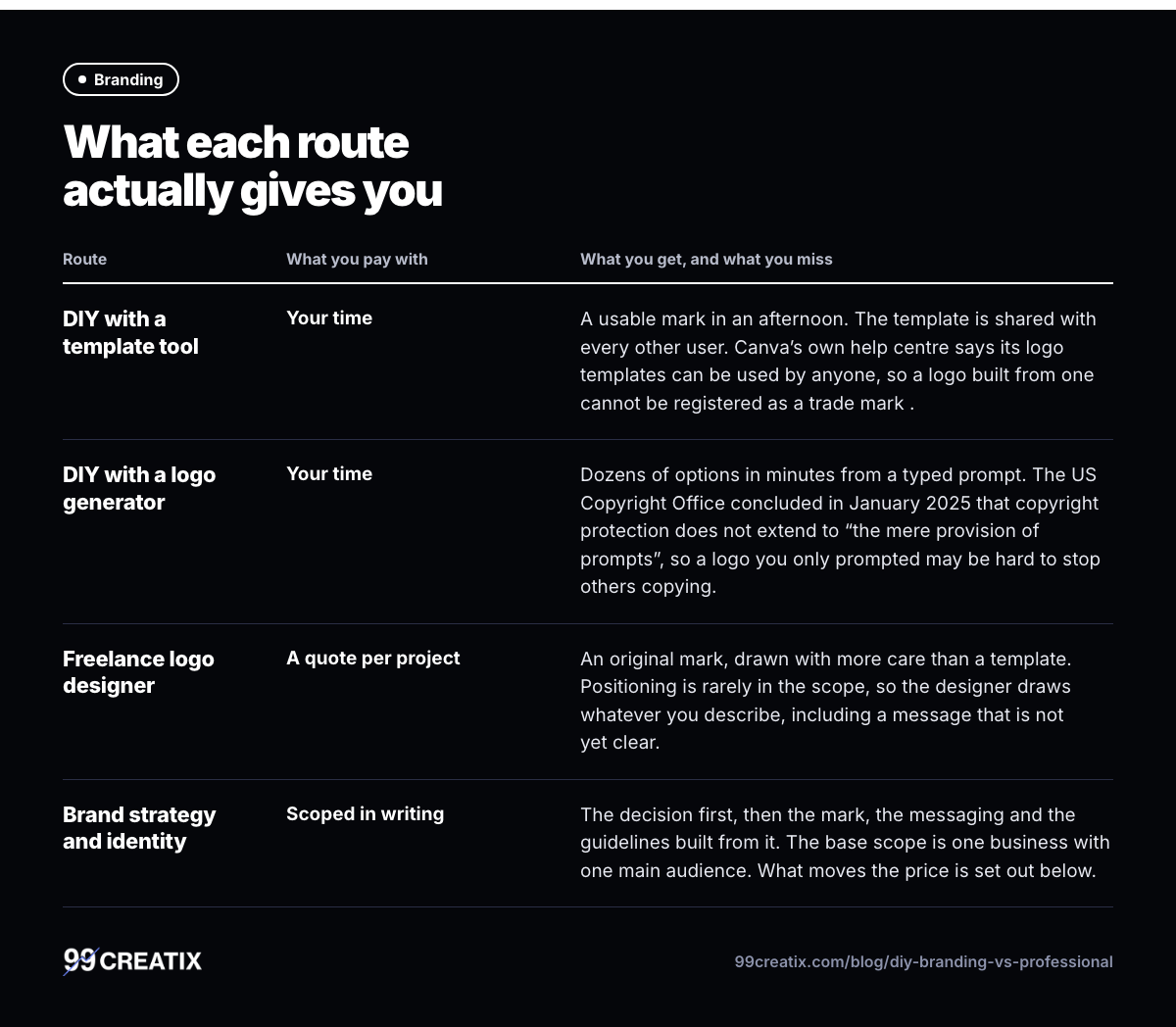
The table is not a ladder that every business should climb. Each row is the right answer for somebody, and the next two sections say who.
DIY branding is fine when
Doing it yourself is the right call more often than designers admit. It is fine when most of these are true.
- The business is early. You are still finding out who buys. An identity bought before you know that is an identity you pay to redo once you do.
- You sell one product or service to one kind of buyer. One message, one audience, and nothing for a brand to choose between.
- The positioning is already clear. Someone who knows you socially can say what you do without prompting. That is the test in say one clear thing, and passing it means the hard part is done.
- You make every branded thing yourself. Nobody else applies the brand, so the rules can live in your head for now.
- You do not need to register the mark yet. A template logo is a placeholder you can replace, not an asset you can defend.
In that position, pick one typeface, two colours and a simple mark, and use them the same way everywhere. At this stage consistency does more work than originality.
When it stops being fine
- Other people start applying the brand. A second salesperson, a printer, a freelancer making ads. Without written rules each one improvises, and the brand drifts a little with every file.
- You want to own the mark outright. Registering a trade mark, or selling the business, turns a template or prompted logo into a liability. The thing you want to protect may not be protectable.
- You add a second audience or market. The sentence that worked for one buyer now has to choose between two. That choice is positioning, not design.
- People cannot say what you do. Referrals stall and enquiries arrive for the wrong service. A better logo will not fix it.
- You are about to spend on applied assets. Signage, packaging, vehicle livery and a new website are expensive to change once made. Settle the brand before it is printed, not after.
The part DIY skips is the part that matters
Every DIY tool starts at the mark. Pick a style, a colour, an icon. None of them asks who you are for, or who you are not for, because a tool cannot tell you what to give up. That decision is positioning, and it is what makes a business easy to recommend.
It is also what a professional is paid for, whatever the invoice calls it. In our own work, positioning is week one. It is built from your actual clients and competitors, and it ends in a statement you either recognise or reject. The logo comes in week two, because a mark can carry a decision but cannot make one.
Positioning is not only for hire. The method in say one clear thing is the DIY version, and it takes an afternoon with last year's revenue by service. The step people skip is the uncomfortable one: demoting services that still earn money. If you can do that honestly on your own, a template logo on top of it will serve you well for a while.
Ownership: the question both routes get wrong
DIY and hiring each carry an ownership trap, and they are different traps.
On the DIY side, the limits are the ones in the table. Template and stock elements are licensed to every user. Canva says the parts you can use in a mark you plan to register are its fonts and simple lines and shapes. A logo made only by prompting an AI tool may have no copyright to register at all, at least in the US.
On the hiring side, paying for a logo does not by itself make it yours. The UK government's guidance on copyright ownership says the first owner of a commissioned work is whoever created it, not the commissioner, unless agreed otherwise in writing. Ask for the assignment clause before the first sketch. Ours transfers files and rights on completion, and how to read a website quote shows what a missing ownership clause looks like on any proposal.
What hiring us costs, and what moves it
Our branding and strategy work starts at $1,800, published on the pricing page. It is priced as one piece of work and not split into line prices, because each part is built on the one before. Here is what it delivers, and when.
- Positioning, week one. The one thing you are for and who you are not for, from interviews and a competitor review.
- Visual identity, week two. Logo, palette, type and the rules for using them, designed to work as a favicon and on a shopfront sign.
- Messaging system, weeks two to three. Headline, elevator line, proof points and the words you will never use.
- Brand guidelines, week three. One document short enough that a freelancer will read it.
$1,800 is a floor for a single business with one main audience, not a price for every brand. Several audiences or markets move it. So do naming work, a large rollout of applied assets such as signage and packaging, and positioning that needs more evidence than a first round of interviews gives, which also adds time. How urgently you need it, and how large the business looks, do not. What a logo alone and a rebrand cost is covered in how much branding costs.
The $1,800 branding and strategy price is our published price. Its four deliverables and their weeks, the typical three-week timeline and the transfer of files and rights on completion are our published scope, from the pricing and branding service pages. The price is not itemised by deliverable. Canva's help centre article Trademarking logos created on Canva says its logo templates cannot be registered as trade marks. The same article says its fonts, simple lines and simple shapes can be used in a registrable mark. The article was read on 15 September 2026 and shows no publication date. The position that copyright does not extend to the mere provision of prompts is from the US Copyright Office's Copyright and Artificial Intelligence Part 2 report, published 29 January 2025. The UK ownership rule for commissioned work is from GOV.UK's Ownership of copyright works guidance, published 19 August 2014. The route comparison, the two lists of when DIY is and is not fine, and the suggested order are our editorial judgement, not survey data, and none of it is legal advice.
A sensible order if you are unsure
- Run the positioning test first. It is free, it takes one phone call, and it tells you whether you have a branding problem at all.
- If people describe you accurately, do the visuals yourself, keep them consistent, and spend the budget on being found.
- If they cannot, work on positioning before anything visual, on your own or with help.
- Before registering a mark or printing anything expensive, confirm you own the mark outright, whoever made it.
Most small businesses need step one and either step two or step three. Few need all four in the same month.