
Comparing web design agencies on portfolio and pricing sounds like two columns on a spreadsheet. In practice one column is empty, because most agencies publish no price, and the other is full of screenshots that prove nothing. This piece gives you a way to fill both columns with the same information from every agency, so you are comparing like with like.
The short version. Compare agencies on four things, in this order: whether they publish a price, what their portfolio proves rather than shows, the written scope and timeline behind the quote, and the terms. In our study of 50 top-listed agencies, 78.6% of the reachable ones published no prices at all, so the first test shortens the list before you have opened a single portfolio. Our own floor is $4,900 for a custom build of up to eight pages, itemised below. What moves it is scope.
- In our study, 78.6% of reachable top-listed agencies published no price, so asking for one shortens the list before any portfolio is opened.
- A portfolio proves something only when the site is still live and a number with a timeframe sits beside it.
- Put every quote on one eight-line table: pages, design, build, copy, technical SEO, analytics, timeline and terms, because equal totals rarely contain equal lines.
- Our build is $4,900 for up to eight pages with copy, tracking, ownership and a 30-day guarantee included, and only scope moves it.
- For a brochure site with no search leads expected, a DIY platform at $125 to $360 for year one is the honest answer and no comparison is needed.
Start with the price, because most agencies hide theirs
We sampled 50 agencies from Clutch's US and UK lists, DesignRush and OneLittleWeb. Of the 42 we could reach, 33 published nothing about price, which is 78.6%. Only 14.3% published a concrete figure and 7.1% a range. Among the agencies that did publish, the median custom small-business build was $7,000, from a sample of six, with a range of $4,000 to $18,000. A basic brochure site was $799.
Why this is the first test and not the last. An agency with no published price can charge what you look able to pay. It also cannot be compared without a call, which is the point of hiding it. Put the no-price agencies on a second list and come back to it only if the first list fails you.
Read a portfolio for outcomes, not screenshots
A portfolio shows what was launched. It does not show whether the site worked, whether it is still live, who did the work, or what it cost. Four questions to ask of every piece in it.
- Is the site still live, and still the design shown? Open it. A redesign by someone else within a year says something.
- What changed for the business? A number with a timeframe. Without one, the piece is decoration.
- Who did the work? The team you will get, a partner studio, or freelancers who have since left.
- What did it cost and how long did it take? An agency that will not say for past work will not say for yours.
Our results page names no clients, on purpose, and says so. It gives the number and the window instead: 47% more organic traffic in ninety days for a UK fashion house, 3.4 times the non-branded clicks in six months for a UAE law firm. Judge any portfolio by whether it can be read that way.
Put every quote on one table
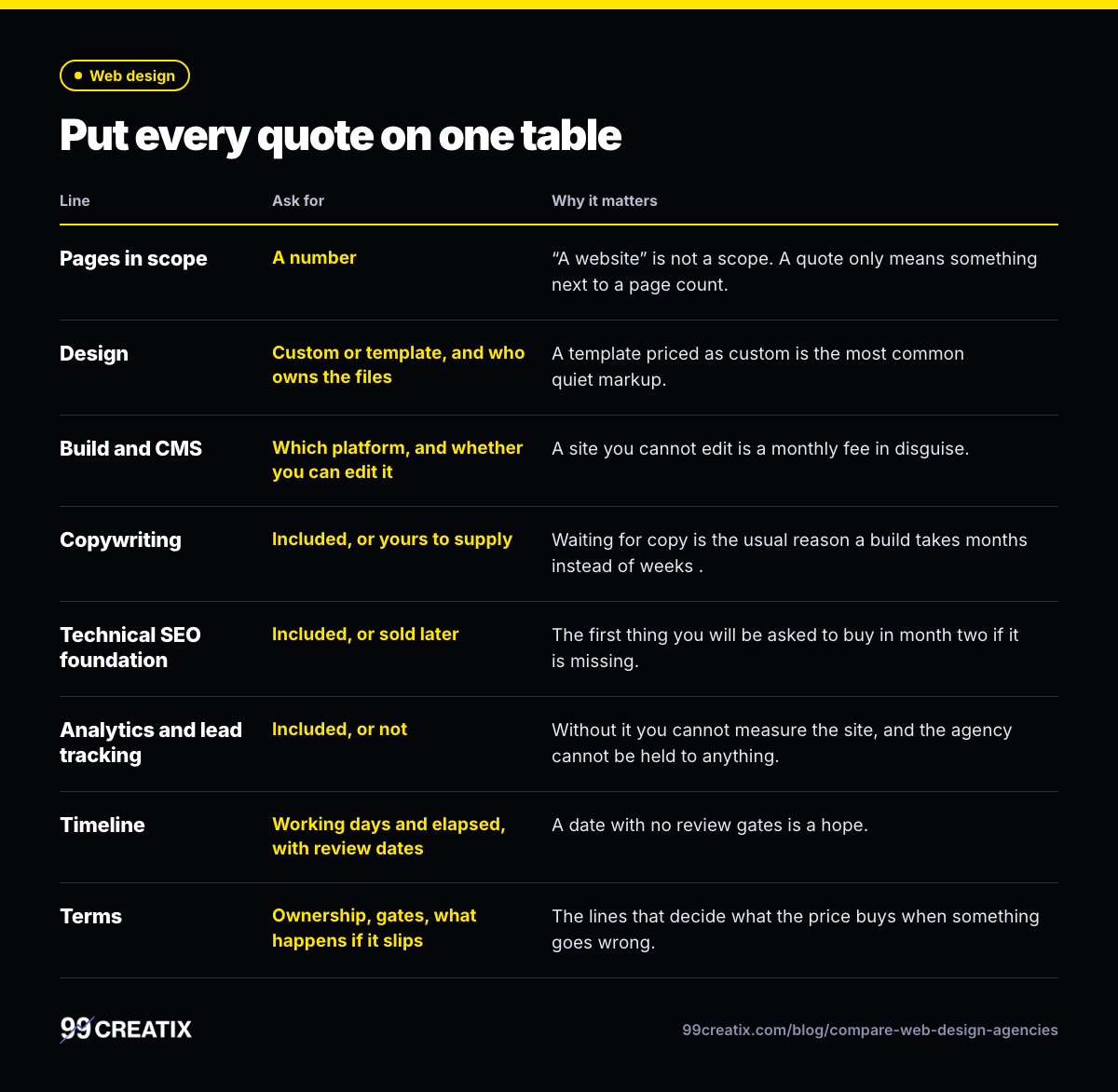
Two quotes with the same total rarely contain the same eight lines. One includes copy and tracking; the other sells them in month two. Comparing totals compares nothing.
Our row in the table
$4,900 for up to eight pages: custom design $2,600, build and CMS setup $1,450, technical SEO foundation $500, copywriting for every page $350. Analytics and lead tracking, full ownership of the files and the 30-day guarantee are included. Live by day 30 or the build month is free, in the contract, with review gates at day 10 and day 22. Branding is separate at $1,800, or $6,350 for both bought together. Every line is on the pricing page and the 30-day launch page sets out the five phases.
What moves the price: more than eight pages, e-commerce, where the floor is $5,900, or custom integrations such as booking engines or a CRM. A second language, migrating a large site with years of URLs, and original photography move it too. What does not: how urgently you need it, how large the business looks, or anything found after the scope is signed. What a website actually costs walks through each line.
Send the eight-line table to every agency on your list and ask each to fill it in. The ones that return it have made themselves comparable.
The ones that reply with a call booking link have answered too.Five questions for a fifteen-minute call
- What is your price for a site of my scope, before we talk further? A floor with a scope attached is an answer. A range is not.
- Which three live sites are closest to mine, and what changed for those businesses?
- What is not in this quote that I will need in the first year?
- What happens on day 31 if it is not live?
- Who owns the files, the domain and the analytics when we part?
An agency that answers all five in fifteen minutes is comparable. One that needs a discovery workshop to answer the first is telling you something about how it prices.
The 50-agency sample, the 42 reachable, the 78.6%, 14.3% and 7.1% shares, the $7,000 median from six USD prices with its $4,000 to $18,000 range, the $799 brochure figure and the $125 to $360 DIY year-one range are all from our own web design prices study published 30 August 2026. Our $4,900 build and its four lines, the $5,900 e-commerce floor, the $1,800 branding fee, the $6,350 bundle and the day 10 and day 22 gates are published prices and terms. The 47% and 3.4 times figures are single-client results from the results page, not averages. The eight-line table, the four portfolio questions, the five call questions and the three cases where the comparison is the wrong exercise are our editorial judgement. No third-party statistics are cited.
When this comparison is the wrong exercise
A five-page brochure site with no leads expected from search. A DIY platform runs $125 to $360 for year one in our study, before your own time. No agency comparison is needed, and we would say so on the call.
No scope yet. Fill in the eight-line table for yourself before sending it to anyone. What the first screen has to do and how people decide are the two pieces that make the page count honest.
A business where the site is a business card. If every customer comes by referral, a comparison of eight-page builds is an expensive way to choose a brochure.
When none of those apply, the comparison works as long as every agency fills in the same eight lines. The ones that will not have already answered.