
Search agency against freelancer against doing it yourself, and each result is written by one of the three. Builders say DIY, marketplaces say freelancer, agencies say agency. Almost none put real prices for all three paths side by side, which is the only way to compare them.
The short version. On published figures, a DIY builder costs $125 to $360 in year one before fees and your own hours. Upwork's hiring guide prices a small-business website at $2,000 to $9,000. The median custom build among agencies that publish a price is $7,000, and ours starts at $4,900 for up to eight pages, live in thirty days or the build month is free. The bigger differences are who does the thinking, who fixes it when it breaks, and what you own when you leave.
- A DIY builder costs $125 to $360 in year one at a business-capable tier, or $250 to $590 with e-commerce, before fees and your own hours.
- Upwork's own hiring guide prices a small-business website at $2,000 to $9,000, a range Upwork publishes and that moves with pages, copy and search.
- The median custom build among agencies that publish a price is $7,000 from a sample of six, and page count, integrations and e-commerce move it.
- Compare the paths on who writes the copy, whether search is built in, what you own and who fixes it, not only the headline price.
- DIY wins when the site only confirms you are real, and an agency wins when the site has to find strangers and turn them into enquiries.
What each path costs, from published numbers
Every figure here comes from a public page, and each comes with what moves it.
- DIY builder: $125 to $360 in year one. That is annual billing at the business-capable tier across six platforms in our prices study, collected in August 2026. Real e-commerce moves it to $250 to $590. It excludes transaction fees on some plans, paid apps, the domain after year one, and your own time.
- Freelancer: $2,000 to $9,000. That is Upwork's range, from its own hiring guide for a small-business website project, as captured in our study. It is not our estimate. A spread that wide is scope: how many pages, whether copy and search are included, and the freelancer's rate.
- Agency: a $7,000 median. Among the six agencies in our study that publish a custom small-business build in US dollars, the median was $7,000 and the range $4,000 to $18,000. Page count, integrations, e-commerce and how much strategy is included move it. Most agencies publish nothing: 78.6% of the 42 we could reach.
- Our build: from $4,900. That is the floor for a custom site of up to eight pages, with design, build, copy, technical SEO and tracking itemised. More pages, a store (from $5,900), custom integrations, a second language, a large migration or original photography move it. Ongoing work is separate and on the pricing page.
The three paths side by side
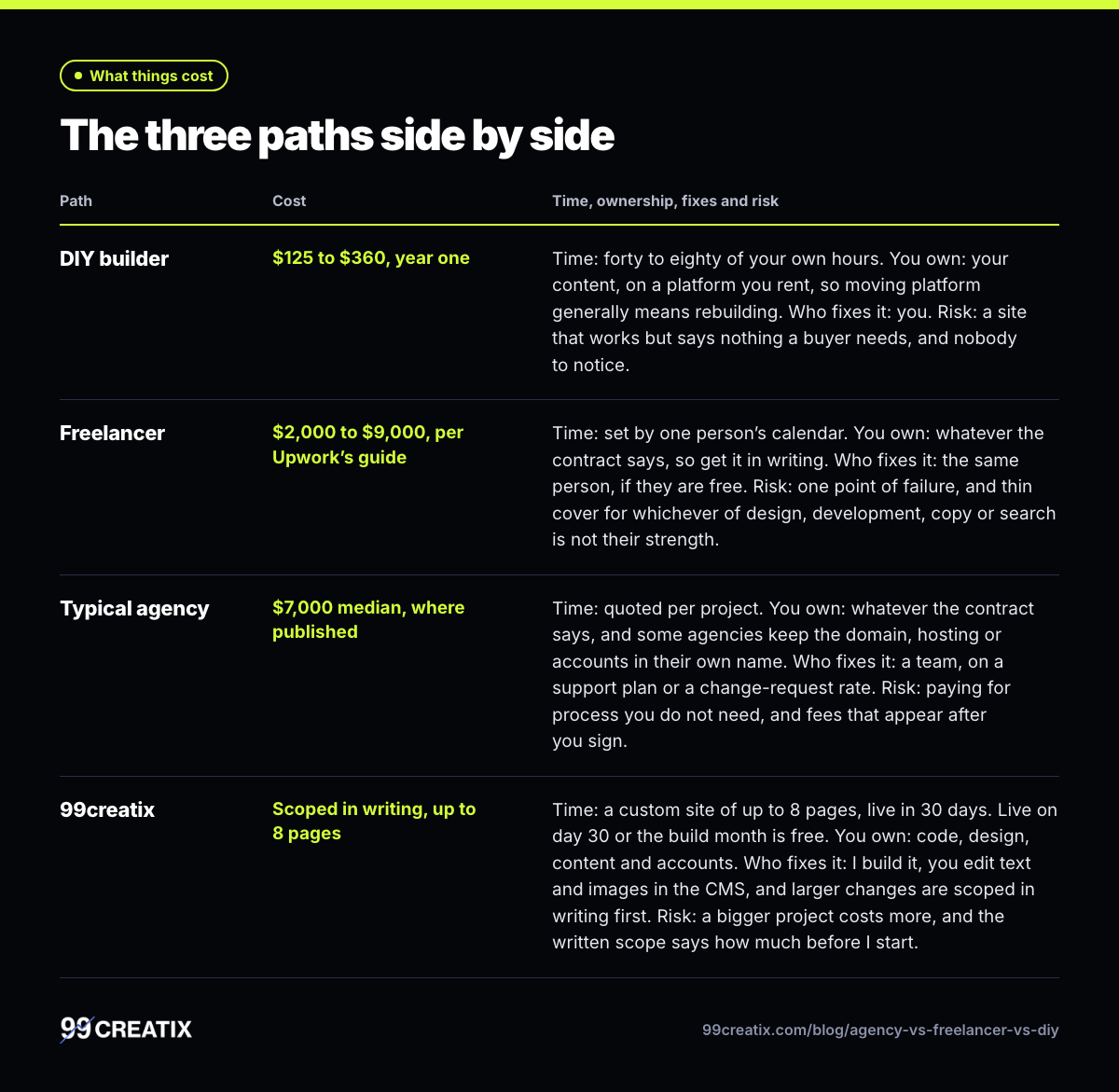
What the headline price leaves out
The cheapest row is not the cheapest path if it leaves out the work a site needs to earn its money. Four questions separate a low price from a small scope.
- Who writes the words? Many quotes assume you will, and a build then waits weeks for copy. How long a website takes explains why that is the most common delay.
- Is search built in or bolted on? Site structure, speed, schema and a sitemap are cheap decisions during a build and expensive retrofits afterwards.
- Will you know whether it worked? Analytics and lead tracking cost little at build time and are the only way to judge the spend.
- What happens when it breaks? A plugin update fails in month seven. Who fixes it, how fast, and at what rate?
Then there are the costs that sit outside any quote, such as marked-up ad spend, setup fees and the price of leaving. They get their own piece: the fees agencies hide.
When each one wins
DIY wins when
The site exists so people can check you are real before calling a number they already have. You have one offer and it is easy to explain. You have the hours, and two extra enquiries a month would take years to pay back a build. In those cases DIY is the right answer, and spending $4,900 with anyone would be a mistake.
A freelancer wins when
You already know what the site needs to say, you have the copy or a writer, and the job is mostly execution. A good freelancer with a written brief can be the best value on this page. Look at sites they launched a year ago, get ownership in writing, and ask who covers the work if they are ill mid-build.
An agency wins when
The site has to be found by people who have never heard of you and turn them into enquiries. That job needs structure, copy, search and tracking decided together, with one party accountable for all four. It also wins when a deadline matters, because a team can absorb one person's absence.
The honest limit on us: if the project needs daily in-house development or a large team on site, a 14-person agency is the wrong fit. We would rather say so on the first call. The wider decision, rung by rung, is in what a website actually costs.
The $4,900 floor for a custom build of up to eight pages and the $5,900 e-commerce floor are our published prices, listed on the pricing page with what moves them. The DIY year-one costs, $125 to $360 at a business-capable tier or $250 to $590 with e-commerce, are from our web design prices study, collected 30 August 2026. The $7,000 median custom build (n=6 in USD, range $4,000 to $18,000) and the 78.6% no-published-price figure come from the same study. The $2,000 to $9,000 range is Upwork's own hiring guide for a small-business website project, as captured in that study in August 2026. Upwork blocked automated access when re-checked on 15 September 2026, so the figure rests on the study capture and is attributed to Upwork. The hiring questions and the quote on ranking guarantees are from Google Search Central's guidance on hiring an SEO, last updated 5 June 2026. The forty-to-eighty-hour DIY estimate, the time, ownership, fixes and risk descriptions in the comparison, and when each path wins are editorial judgement.
Questions to ask whichever you choose
Google's guidance on hiring an SEO suggests asking for examples of previous work, what results to expect and in what timeframe, and whether they will share every change they make to your site. It also says plainly: "No one can guarantee a #1 ranking on Google." Those questions work for all three paths. Add three of ours.
- What exactly is in the price, line by line, and what would move it?
- Whose name will be on the domain, hosting and analytics on launch day?
- If something breaks in month seven, who fixes it and what does that cost?
Put each option's answers into the table above. The path that leaves the fewest blank cells is the one to trust, whatever its headline price.
If you are building it yourself, answer the questions for yourself. The blanks show up just the same.