
Most articles about agency hidden fees are written by a software company selling a way around agencies, or by an agency describing what other agencies do. Neither publishes its own fine print next to the list. That is the one thing a buyer needs to test the claim.
The short version. Five fees rarely appear on a proposal as fees: a markup on ad spend, a setup fee, change requests, the cost of leaving, and an automatic annual renewal. None is illegal, and some can be fair. Each is hard to see when you are deciding and obvious when you try to leave. Below is how to spot each one, the question that exposes it, and our own terms in full.
- Five fees rarely appear as fees: the ad spend markup, the setup fee, the change request, the exit cost and the rollover.
- Hidden pricing lets a quote fit what a buyer looks able to pay, and in our study 78.6% of reachable top-listed agencies published no prices.
- Each fee has a question that exposes it, such as whose card is on the ad account and whose name is on the domain.
- A fee written into the proposal with a number or a rule is a pricing model, and one that appears after you sign was designed not to be seen.
- Our terms are ad spend at cost, no setup or cancellation fee, no annual lock-in, and everything yours when you leave.
Why agencies hide the price at all
In our study of 50 top-listed web design agencies, 78.6% of the 42 we could reach published no prices at all. Some asked visitors to declare a budget in a contact form while publishing none of their own numbers. The disclosure runs one way.
The reason is not complicated. A quote given after a call can be fitted to what the buyer looks able to pay, and a published price cannot. The same logic drives every fee below. A fee that appears after you have said yes is not competing with anyone. How retainers are structured, and who carries the risk under each model, is covered in what a marketing agency retainer costs.
Fees in the money: the markup and the setup fee
1. The ad spend markup. You approve a budget for Google or Meta, and part of it never reaches the platform. The ads run in the agency's own account, the spend is invoiced to you with a margin on top, and the margin never appears as a fee.
How to spot it: the proposal quotes one monthly figure that includes media, or says spend is "managed" without saying whose account pays the platform. A disclosed percentage of spend is a different thing, because you can see it. The question: whose card is on the ad account, and will I see the platform's own invoice? The honest answer is your card, and yes.
2. The setup fee. It appears after you agree, under a name like onboarding, discovery or account configuration. It is charged for the work of becoming a customer.
How to spot it: a line on the first invoice that was not in the first quote, or a "month zero" in the timeline. The question: is anything billed before the first month of the work I am buying, and what exactly does it produce? A setup fee that produces a written audit you keep is a deliverable. One that produces access to the agency is a toll.
Fees in the scope: the change request
3. The change request. Everything outside the scope is billed as extra. When the scope was never written down, everything is outside it.
How to spot it: the proposal lists activities rather than deliverables. "Ongoing optimisation" and "revisions as needed" cannot be checked. "Up to eight pages, two review rounds" can. The question: what is the written scope, how many revision rounds does it include, and what is the rate for anything outside it? Ask for that rate before signing, not when you need it.
A fair version of this fee exists. Work outside a written scope should cost money. The unfair version is a scope vague enough that the agency decides afterwards what was in it.
Fees at the exit: ownership and the rollover
4. The exit cost. You leave. The site is on their hosting, the analytics is on their account, and the domain is registered in their name. Ownership becomes a negotiation, and the price of leaving is whatever they ask for the keys.
How to spot it: the contract has no ownership clause, or one that transfers rights only on payment of every sum owed, which can include a notice period. The question: if I leave next month, what do I take with me, and whose name is on the domain, hosting, analytics and ad accounts today? Google's guidance on hiring an SEO suggests asking whether they will share all the changes they make to your site. That habit makes leaving cheaper too.
5. The rollover. An annual contract renews for another year unless you cancel inside a notice window you were told about once, on the day you signed.
How to spot it: the words automatic renewal or successive terms, and a notice period counted back from an anniversary rather than forward from today. The question: what is the minimum term, and on what exact date would I need to give notice to leave at the end of year one? Put that date in your calendar the day you sign.
The five questions on one page
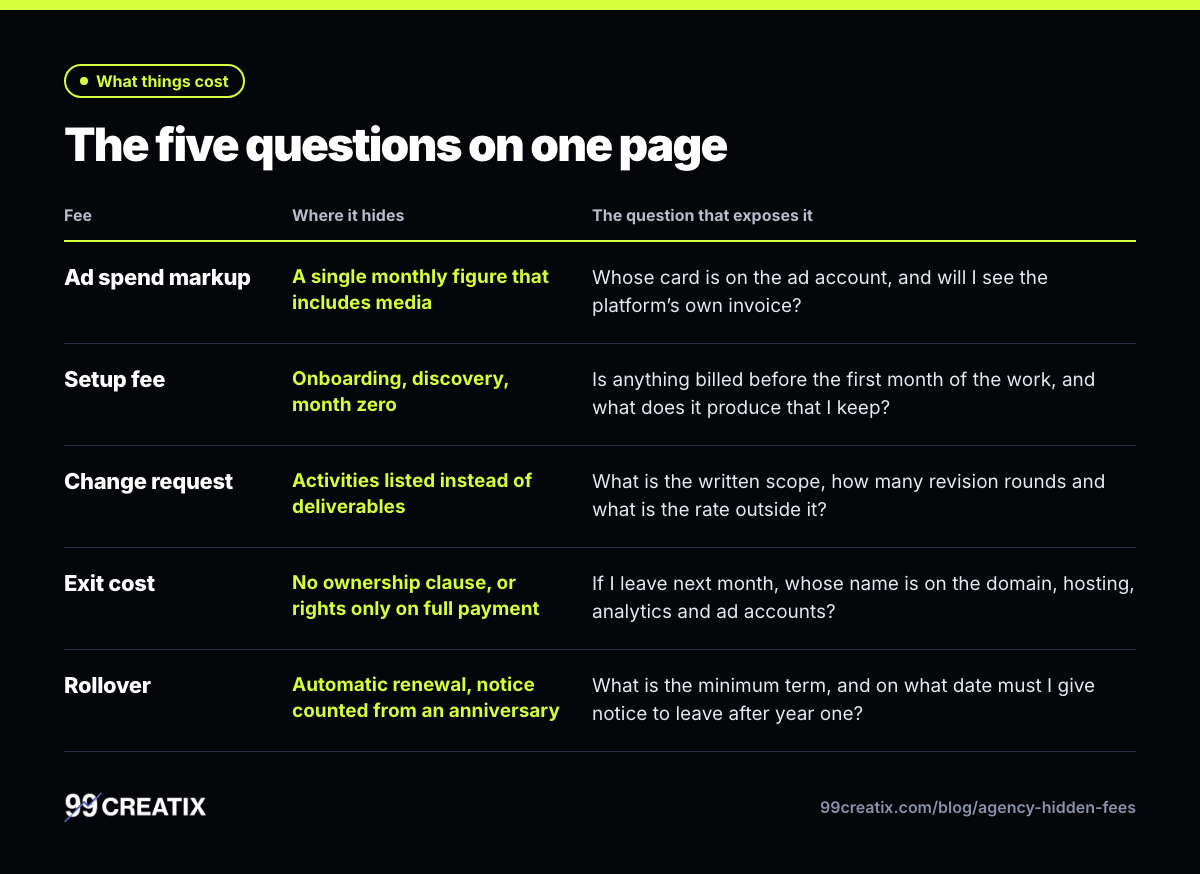
Ask all five in writing and keep the replies with the contract. The time an answer takes to arrive is information too.
Our fine print, in full
A list like this is only worth reading if the author answers it. Here are ours, and every line is also on the pricing page.
- Ad spend is billed at cost, never marked up. It goes from your own account to Google or Meta.
- No setup fee.
- No cancellation fee and no annual lock-in. Monthly work runs on a rolling thirty-day term.
- Code, design, content and accounts are yours. If we part ways, everything goes with you.
- The scope is agreed in writing on day one, and the number does not move after that.
- A build is live by day 30 or the build month is free. If we are waiting on your content, the clock pauses.
- Prices are in USD, with GBP, EUR and AED at checkout.
Published prices are floors with a scope, not flat rates. A custom build is $4,900 for up to eight pages, and every service we sell is listed with its price on one page. More pages, a store (from $5,900), custom integrations, a second language or market, a large migration and original photography move it. How urgently you need it, how large your business looks, and anything discovered after the scope is signed do not. How that floor is built, line by line, is in what a website actually costs.
The $4,900 build floor for up to eight pages and the $5,900 e-commerce floor are our published prices, listed on the pricing page with what moves them. Our terms are published on the same page: ad spend billed at cost, no setup fee, no cancellation fee and no annual lock-in. So are the rolling thirty-day term, full ownership of code, design, content and accounts, and the 30-day launch guarantee. The 78.6% no-published-price figure is from our study of 50 top-listed web design agencies, collected 30 August 2026. So is the observation that some agencies ask for a buyer's budget while publishing none of their own. The suggested question about sharing site changes is from Google Search Central's guidance on hiring an SEO, last updated 5 June 2026. The five fees, where each hides, the questions that expose them and the view on when a fee is fair are editorial judgement. No agency is named and no third-party fee levels are cited.
When a fee is not a trick
Not every fee on this list is a scandal, and an agency charging one is not automatically hiding anything. A percentage of ad spend, written into the contract, is a pricing model. A minimum term is reasonable when an agency front-loads work it recovers over several months. A paid audit you keep is a fair charge. Hosting in the agency's name can be fine if the transfer terms are written down.
The test is the same for all five. Is it in the proposal, before you sign, with a number or a rule attached? If it is, you can compare it with anyone else's. If the answer only arrives after you ask twice, the fee was designed not to be seen.